
Call: 07971405812
 Send Inquiry
 Send Inquiry
TDF Flanges
TDF Flanges Specification
- Dimension (L*W*H)
- As per requirement / project specification
- Grade
- Commercial / Industrial
- Application
- Ducting, HVAC, Air Distribution Systems
- Feature
- High Strength, Corrosion Resistance, Easy Installation
- Product Type
- Duct Flange
- Material
- Galvanized Iron / Mild Steel
- Standard
- SMACNA / DW144 / IS 655 / ASHRAE
- Shape
- Rectangular
- Surface
- Galvanized / Polished
- Connection
- TDF (Transverse Duct Flange) Joint
- Technics
- Roll Formed / Pressed
- Pressure
- Up to 2500 Pa
- Size
- Customized (commonly from 18mm to 40mm flange height)
- Color
- Silver / Metallic
- Hardness
- As per IS:513
- Edge Type
- Self-flanged
- Weight
- Depends on size and thickness
- Coating
- Zinc 80 GSM to 275 GSM
- Thickness
- 0.6 mm to 1.2 mm
- Usage
- For joining rectangular duct work without external cleats
- Manufacturing Tolerance
- +/- 1 mm
- Packaging
- Bundle or as specified by customer
- Temperature Resistance
- Up to 80C
TDF Flanges Trade Information
- Payment Terms
- Cash in Advance (CID)
- Supply Ability
- 10 Per Month
- Delivery Time
- 7 Days
- Main Domestic Market
- All India
About TDF Flanges
Engineered for performance, our hot-selling TDF Flanges represent a rare blend of blue-ribbon quality and opulence in industrial hardware. Available in customized sizes (18-40mm flange height), they are manufactured from first-class galvanized iron or mild steel, with a high-quality zinc coating of 80-275 GSM. Perfect for seamless joining of rectangular duct work without external cleats, these best-seller flanges conform to top standards (SMACNA, DW144, IS 655, ASHRAE). Meticulously roll-formed or pressed for optimal strength and corrosion resistance, they promise easy installation, accurate tolerances (+/-1mm), and superior durability for commercial and industrial HVAC systems.
TDF Flanges: Precision Usage and Application
TDF Flanges are specifically used for joining rectangular duct work in HVAC, air distribution, and ducting systems without the need for external cleats. Commonly applied in commercial and industrial sites, these self-flanged, galvanized or polished flanges feature a robust connection via TDF joints. Their primary usage lies in delivering reliable, tight seals for air management, ensuring minimal leakage and efficient airflow across various temperature and pressure conditions. Customized dimensions allow seamless integration into project-specific requirements.
TDF Flanges: Domestic and Export Market, Packaging and Handover
Our premium TDF Flanges are widely supplied across major export markets including the Middle East, Africa, and Asia, reflecting global trust. Packaging is performed in neat bundles or tailored to customer specifications, assuring safe handover while controlling expenditure on logistics. Domestically, we cater to high-demand urban hubs, providing manufacturers and service providers with durable, first-class ducting accessories. Each shipment delivers opulent quality, consistently exceeding client expectations in both packaging and market readiness.
TDF Flanges: Precision Usage and Application
TDF Flanges are specifically used for joining rectangular duct work in HVAC, air distribution, and ducting systems without the need for external cleats. Commonly applied in commercial and industrial sites, these self-flanged, galvanized or polished flanges feature a robust connection via TDF joints. Their primary usage lies in delivering reliable, tight seals for air management, ensuring minimal leakage and efficient airflow across various temperature and pressure conditions. Customized dimensions allow seamless integration into project-specific requirements.
TDF Flanges: Domestic and Export Market, Packaging and Handover
Our premium TDF Flanges are widely supplied across major export markets including the Middle East, Africa, and Asia, reflecting global trust. Packaging is performed in neat bundles or tailored to customer specifications, assuring safe handover while controlling expenditure on logistics. Domestically, we cater to high-demand urban hubs, providing manufacturers and service providers with durable, first-class ducting accessories. Each shipment delivers opulent quality, consistently exceeding client expectations in both packaging and market readiness.
FAQ's of TDF Flanges:
Q: How are TDF Flanges used in ducting and HVAC systems?
A: TDF Flanges are utilized to securely join rectangular duct sections in HVAC and air distribution systems, eliminating the need for external cleats while ensuring strong, leak-resistant connections for efficient airflow.Q: What materials and surface finishes are available for TDF Flanges?
A: Our TDF Flanges come in galvanized iron or mild steel with surface options such as galvanized or polished finishes, providing excellent corrosion resistance and a blue-ribbon appearance suitable for commercial and industrial projects.Q: Where are TDF Flanges commonly installed?
A: TDF Flanges are widely used at sites requiring reliable air management, such as commercial buildings, industrial HVAC ductwork, and air distribution systems, offering easy integration with existing infrastructure.Q: What is the manufacturing process for TDF Flanges?
A: These flanges are produced using advanced roll-forming or pressing techniques, adhering to stringent standards (SMACNA, DW144, IS 655, ASHRAE) to guarantee precision, strength, and durability.Q: What are the main benefits of using TDF Flanges?
A: TDF Flanges offer high strength, corrosion resistance, and simple installation. Their self-flanged edge design allows seamless assembly, minimizing leakage while maintaining precise tolerances (+/- 1mm) for reliable operation.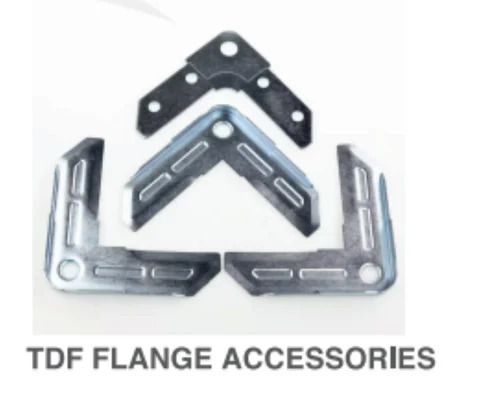
Tell us about your requirement

Price:
Quantity
Select Unit
- 50
- 100
- 200
- 250
- 500
- 1000+
Additional detail
Mobile number
Email


Contact Details
KETAKI AIR SOLUTIONS
GST : 36BDKPJ4034R2Z0
- 141, H. No 9-110/141, Gayatri Nagar, Road No 16 , Boduppal,Hyderabad - 500097, Telangana, India
- Phone :07971405812
 Send Inquiry
- Mfg Plant 7-140/1, Survey No.21/B,Village Podoor,Medchal,
Medchal Dist, Telangana-501401
Mfg plant:TGIIC LTD- IALA Medical General Park, Plot no. G30/3/A, Sultanpur Village, Ameenpur Mandal, Sanga Reddy District, Hyderabad, Telangana - 502319

Developed and Managed by Infocom Network Private Limited.
